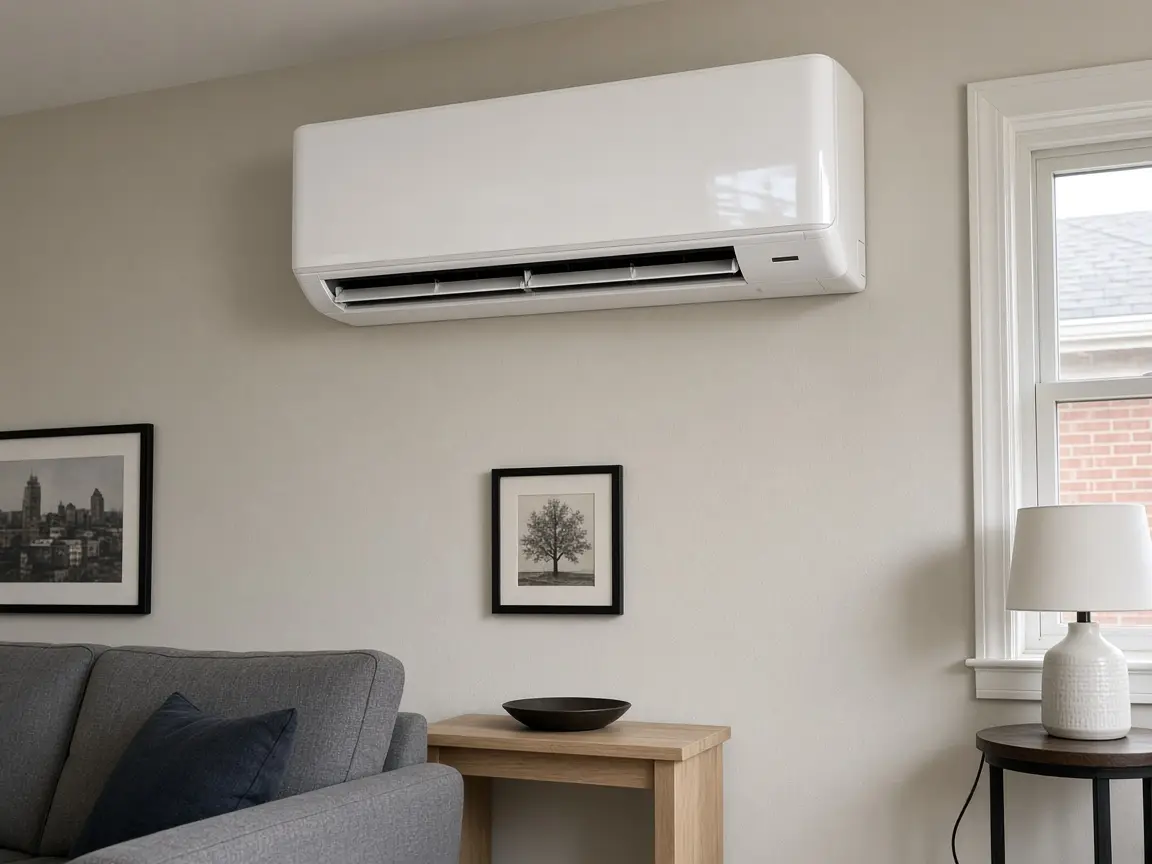
The choice between ducted and ductless usually comes down to one question: do you already have ducts, and are they any good? If yes, a ducted heat pump is typically cheaper and less visible. If no, a ductless mini split avoids the several thousand dollars it costs to add duct work to an existing house. The house tends to make the decision for you.
What each one is
A ducted heat pump connects to a central air handler and distributes heat and cooling through ductwork, the same way a central furnace and AC do. From inside the house it looks and feels like conventional central air.
A ductless mini split skips the ducts. An outdoor unit connects by a small refrigerant line to one or more indoor heads mounted in the rooms you want to condition. Each head is its own zone with its own control.
The cost comparison
The single biggest cost driver is whether ducts already exist and are in good condition.
- You have good ducts. Ducted is usually the cheaper install, because you reuse the distribution system you already own. A ducted air source system typically runs $9,500 to $22,000 installed before incentives.
- You have no ducts. Adding ductwork to a finished house is invasive and expensive, often several thousand dollars on its own. Ductless avoids that entirely. A single-zone mini split runs roughly $2,800 to $8,500 installed, and multi-zone systems scale with the number of heads. The mini split cost page breaks this down per zone.
- You have bad ducts. Leaky ducts in an unconditioned attic can waste a real share of your heat. Sometimes sealing them is worth it, sometimes a ductless retrofit is the better spend. This is the case where the math is genuinely close and worth modelling.
Efficiency and comfort
Ductless has two structural advantages. It avoids duct losses, which can be significant in older or attic-run duct systems, and it gives you true zoning, so you heat the rooms you use rather than the whole house at one setpoint.
Ducted delivers even, whole-home temperatures from hidden equipment, and pairs naturally with central filtration and fresh-air ventilation. A tight, well-sealed duct system in conditioned space performs beautifully. The problem is that a lot of existing duct systems are neither tight nor in conditioned space.
Looks and noise
The most common objection to ductless is the visible indoor head. Modern heads are slimmer and quieter than the ones people remember, and there are floor-mounted and recessed ceiling-cassette options for rooms where a wall unit is unwanted. Ducted keeps all the equipment out of sight, which is exactly why some homeowners with usable ducts choose to stay ducted even when ductless would be cheaper.
A quick side by side
| Factor | Ducted | Ductless |
|---|---|---|
| Best when | Good ducts already exist | No ducts, or ducts are poor |
| Typical install cost | $9,500 to $22,000 | $2,800 to $8,500 per zone tier |
| Duct losses | Possible, especially in attics | None |
| Zoning | Whole-home by default | Per room by default |
| Visibility | Hidden | Indoor heads visible |
| Filtration and ventilation | Easy to centralise | Per-head filters |
The mixed approach
You do not have to pick one for the whole house. A very common and sensible design is ducted where ducts already run, plus a ductless head for the addition, the finished attic, or the back bedroom the ducts never reached. Matching each part of the house to the cheapest way to serve it usually beats forcing a single approach everywhere.
Bottom line
Let the ducts decide. Good existing ducts point to a ducted system on cost and looks. No ducts, or bad ducts, point to ductless and the duct-work savings that come with it. When it is close, model both. The calculator prices your scenario by distribution type, and the mini split cost page shows how ductless scales as you add zones.
Written by HeatPumpAtlasUSA Editorial , reviewed by HeatPumpAtlasUSA Editorial , and updated . Sources are listed below. If a figure looks wrong, contact editorial.